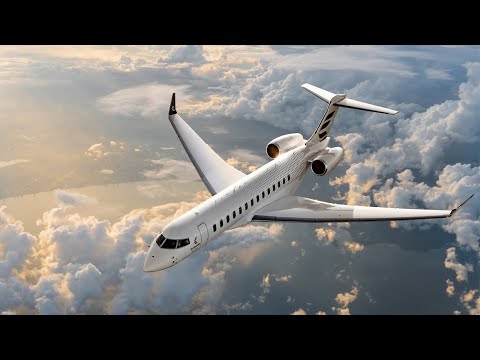
The Bombardier Global 7500 stands out in the ultra-long-range segment with its 7,700 nm range, enabling nonstop flights from New York to Hong Kong or London to Sydney under typical conditions, powered by two GE Passport engines each delivering 18,920 lbs of thrust. Its maximum speed of 561 knots and cruise of 484 knots provide efficient high-speed travel, while the cabin measures 54.42 feet long, 8 feet wide, and 6.17 feet high, yielding 2,637 cubic feet of volume for up to 19 passengers, complete with stand-up space, a flat floor, full galley, shower, and berthing options. Baggage capacity reaches 195 cubic feet, and with a maximum takeoff weight of 114,850 lbs and 6,825 gallons of fuel, it's engineered for reliability up to 51,000 feet.
Compared to the Gulfstream G650ER, a longtime benchmark with a 7,500 nm range and Rolls-Royce BR725 engines, the Global 7500 holds a clear edge in range—allowing about 200 nm farther on the same mission profile—and cabin length, offering 7.6 feet more for superior zoning into multiple living areas without compromising the stand-up height of around 6.25 feet in both. The 7500's newer Passport engines also contribute to slightly lower projected direct operating costs, around $6,200 per hour versus the G650ER's $5,800-$6,000, thanks to better specific fuel consumption, though pre-owned G650ERs trade at $40-55 million compared to $70-75 million new for a 7500 (with recent pre-owned 7500s at $60-70 million). The G650ER pulls ahead in top speed at Mach 0.925 (roughly 516 knots true airspeed) and slightly wider cabin at 8.17 feet, providing a touch more shoulder room, plus a proven dispatch reliability from over a decade in service that edges the 7500's six-year production run.
The Gulfstream G700, Gulfstream's latest ultra-long-range offering certified in 2022 with Rolls-Royce Pearl 700 engines, narrows the gap with a 7,750 nm range and maximum speed of Mach 0.935 (about 522 knots), surpassing the 7500 in both metrics for missions demanding absolute priority on speed or marginal distance. Its cabin volume of approximately 2,650 cubic feet, with dimensions of 56.8 feet long, 8.2 feet wide, and 6.3 feet high, gives it a slight advantage in overall spaciousness and height for taller passengers, accommodating up to 19 seats with similar luxury zoning. New pricing aligns closely at $75-78 million for both, but operating costs for the G700 hover around $6,500 per hour, marginally higher than the 7500 due to its heavier 107,600 lbs MTOW and fuel burn optimized more for speed than efficiency. The 7500 counters with a more established fleet presence, proven lower maintenance intervals on the Passport engines, and 195 cubic feet of baggage versus the G700's 195-200 cubic feet, making it preferable for operators valuing fuel economy on long sectors.
Against the Dassault Falcon 8X, which offers a 6,450 nm range with Pratt & Whitney PW307D engines, the Global 7500 dominates in reach—over 1,200 nm more—cruise speed (484 versus 470 knots), and cabin length (54.42 versus 40.3 feet), delivering a vastly larger 2,637 cubic feet of volume for true transoceanic comfort and 19-passenger capacity. Purchase prices reflect this, with new 8Xs at $60 million versus $75 million for the 7500, and hourly costs around $5,500 for the Falcon due to its lighter 73,000 lbs MTOW. The 8X edges ahead in cabin width (7.8 feet, feeling more intimate yet efficient) and height (6.25 feet), plus superior short-field performance with a 5,600-foot takeoff requirement versus the 7500's 6,000 feet, appealing for airports with runway constraints despite its shorter legs.
Buyers weighing these options should factor mission profiles: the Global 7500 excels for pure ultra-long-range efficiency and cabin livability, but trade-offs in speed or field performance with rivals may tip the scales depending on your global footprint and whether you're sourcing new or pre-owned through your aviation advisor.

 View Photos
 Watch Film
 360° VTour
 Open House